Trustpad tiers: TPAD Stakes and Allocation Weights
Trustpad tiers link qualifying TPAD stakes to sale access and the relative weight of an IDO buying allowance. The published staking schedule starts at Partaker with 20,000 TPAD and reaches Singularity with 10,000,000 TPAD. Levels sit within Guaranteed, All-Access Guaranteed (AAG) and Super All-Access Guaranteed (SAAG) echelons. A tier supplies a base multiplier; the staking duration and echelon determine its allocation booster. Registration establishes participation in a particular sale, whose base allocation determines the final buying limit. A larger multiplier therefore describes purchasing capacity within that sale. It does not describe investment returns, token delivery or automatic entry into every offering.
Updated
Tier weights and sale-access echelons
A tier determines allocation weight, while its echelon can determine access to restricted sales. These roles affect different parts of participation in an initial decentralized exchange offering (IDO). Moving within an echelon raises the base multiplier without changing the echelon itself. Crossing into AAG changes that access classification as well as the numerical weight.
Seed, private and strategic offerings may restrict entry to AAG and SAAG participants unless their terms provide otherwise. A higher Guaranteed tier still belongs to G, even when it carries a substantial multiplier. An AAG or SAAG designation meets an AAG+ offering's echelon condition; other participation requirements remain relevant. The word Guaranteed concerns an eligible buying allowance during the normal sale round, which requires prior registration and funding during that round.
Qualifying stakes and wallet status
The staking dashboard shows the connected wallet's attained tier, effective multiplier and applicable pool benefits. Its disconnected balance and inactive indicators do not establish what another wallet has staked. Direct TPAD staking and TPAD-BNB liquidity-provider (LP) staking provide supported participation routes. The direct route requires staking TPAD in an IDO pool; the LP route requires staking the liquidity position in an IDO LP pool. A wallet balance alone does not establish a qualifying stake.
Stake thresholds across the echelons
The direct staking schedule pairs each TPAD requirement with a base allocation multiplier. Partaker and Contributor mark the ends of G, Associate and Orbit bound AAG and Black and Singularity bound SAAG. The access distinction below applies when an offering restricts entry to AAG and SAAG.
| Tier and echelon | TPAD stake and base weight | AAG+ sale eligibility |
|---|---|---|
| Partaker (G) | 20,000 TPAD; 0.5× | Does not meet the echelon requirement. |
| Contributor (G) | 350,000 TPAD; 10× | Does not meet the echelon requirement. |
| Associate (AAG) | 500,000 TPAD; 15× | Meets the echelon requirement; registration still applies. |
| Orbit (AAG) | 2,000,000 TPAD; 63× | Meets the echelon requirement; registration still applies. |
| Black (SAAG) | 2,500,000 TPAD; 79× | Meets the echelon requirement; registration still applies. |
| Singularity (SAAG) | 10,000,000 TPAD; 333× | Meets the echelon requirement; registration still applies. |
Between the G boundaries, Prospect requires 40,000 TPAD for 1× and Rookie requires 60,000 TPAD for 1.5×. Affiliate requires 100,000 TPAD for 2.5×, Member requires 150,000 TPAD for 4× and Club requires 250,000 TPAD for 7×.
The intermediate AAG tiers start with Manager at 750,000 TPAD for 23× and Executive at 1,000,000 TPAD for 31×. Chief requires 1,250,000 TPAD for 39× and Partner requires 1,500,000 TPAD for 47×.
Within SAAG, Jet Black requires 3,750,000 TPAD for 119× and Obsidian requires 5,000,000 TPAD for 160×. Thermosphere requires 6,250,000 TPAD for 201×, followed by Outer Space at 7,500,000 TPAD for 244×. These multipliers describe base weights before the applicable pool booster.
Lock periods and effective multipliers
The staking period changes the allocation booster without replacing the TPAD requirement for a named tier. The echelon also affects the booster, so stake size alone does not describe the full allocation weight.
Pool durations
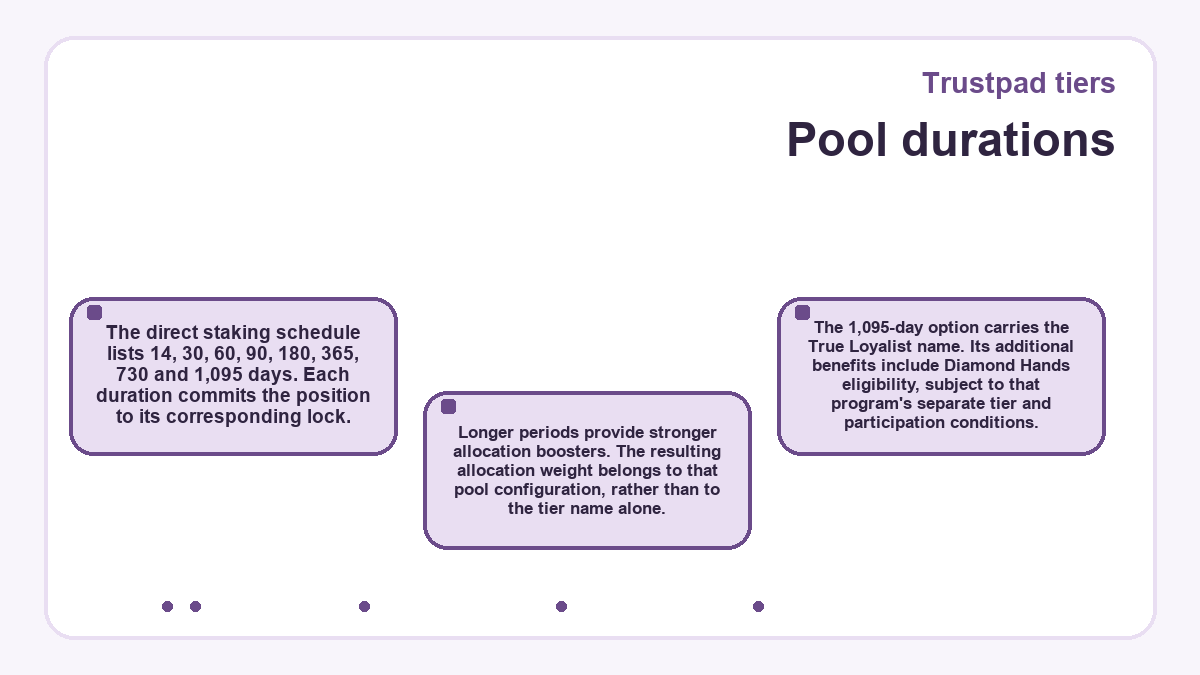
The direct staking schedule lists 14, 30, 60, 90, 180, 365, 730 and 1,095 days. Each duration commits the position to its corresponding lock. Longer periods provide stronger allocation boosters. The resulting allocation weight belongs to that pool configuration, rather than to the tier name alone.
The 1,095-day option carries the True Loyalist name. Its additional benefits include Diamond Hands eligibility, subject to that program's separate tier and participation conditions.
Booster factors
The effective allocation multiplier equals the tier multiplier multiplied by the applicable staking booster factor. A displayed percentage increase must first become a multiplicative factor: one plus the percentage divided by 100. Multiplying the base weight directly by the percentage would omit the original weight.
The staking dashboard displays the effective multiplier for the wallet's position. That value incorporates the applicable booster, so applying the same booster again would double-count its effect.
The allocation base for each sale
A sale's allocation base converts relative tier weights into buying allowances for that offering. The base allocation is set after the sale's registration period closes. The participant's normal-round allowance equals this base multiplied by the effective allocation multiplier recorded for that sale. A later tier upgrade does not immediately update an existing sale registration; re-register at the higher level while registration remains open. The raise and registered participants' respective weights determine the sale-specific base. A fixed tier therefore does not imply a fixed USDT allowance across different IDOs. The displayed buying limit concerns how much a participant can purchase, before any claimable tokens become available.
Registration limits and FCFS access
The registration window
Registration records a qualifying wallet's participation in the chosen sale within its registration window. Staking by itself does not register that wallet for an offering. The sale's own timeline supplies its opening and closing times. A larger tier or longer lock does not extend that window, and Trustpad does not register participants manually.
The end of guaranteed buying
The normal-round allocation is no longer guaranteed once a sale enters its first come, first served (FCFS) phase. FCFS starts only if tokens remain. The standard structure reserves its first two rounds for registered stakers and opens the last two to all TPAD stakers regardless of registration. Sale conditions may restrict the first FCFS round by staking duration and may also limit FCFS eligibility by echelon. A public-whitelist allocation alone does not provide additional FCFS buying rights.
Original tiers and continuing vesting
Upgrades after a purchase
The Diamond Hands rules allow a wallet that later upgraded to return to its original purchase tier. The stake must still cover that tier's historical requirement for the older sale. A matching tier name in another schedule does not establish the original token quantity.
Locks that end before vesting
The original purchase tier must remain staked throughout the remaining vesting period under Diamond Hands retention rules. A tier that remains unstaked or unlocked for 72 continuous hours triggers forfeiture of all future vestings. Lock expiry therefore matters even before a participant withdraws TPAD. A completed sale purchase can leave an ongoing staking obligation while project tokens remain unvested.
Details worth knowing about Trustpad tiers
-
How much does reaching a tier cost in USDT?
- The tier schedule specifies a TPAD quantity, so its USDT acquisition cost changes with the token's purchase price. The required stake and the money used to fund a project allocation cover different commitments. Sales in the documented BNB Chain participation flow usually accept USDT as payment.
-
Are allocation boosters a percentage yield on staked TPAD?
- Allocation boosters increase sale allocation weight and do not describe TPAD staking yield. Annual percentage rate (APR) concerns staking rewards where the selected pool provides them. The dashboard presents the effective allocation multiplier separately from possible APR and other benefits.
-
Must tier holders win a public whitelist competition before entering an IDO?
- Qualifying tier holders use sale registration without needing a public whitelist win. Whitelist competitions offer a separate route to entry-level allocations for some projects. A tier holder still needs to satisfy the particular sale's echelon restrictions and registration requirements.
-
Which tier information appears in the account area?
- The account area shows the wallet's tier and effective allocation multiplier alongside its sale participation history. It also holds sale participation wallet details, participation statistics and access to the know your customer (KYC) process.
-
Does AAG status override the IDO country exclusions?
- AAG status leaves the IDO jurisdiction exclusions in place. The published participation conditions exclude participants or citizens from several countries and territories, including the United States and Canada. The echelon classifies staking-based access; it does not establish eligibility under those geographic restrictions.
-
Can the staking tiers apply to initial NFT offerings?
- The staking framework also covers allocation eligibility for initial NFT offerings (INOs). The levels dashboard includes guaranteed-allocation status for both IDOs and INOs. Eligibility for a specific offering still follows that offering's registration and participation conditions.